

Introduction
Product developers often face a critical choice: should they 3D‑print a component or invest in an injection mold? Each method has advantages and trade‑offs involving setup costs, per‑part pricing, lead time, design flexibility and scalability. This article compares the economics and timing of 3D printing versus injection molding, helping you decide which process suits your project.
How injection molding works
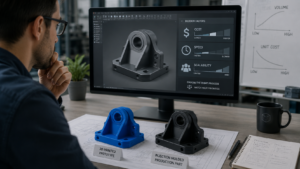
Injection molding involves heating a thermoplastic or thermoset polymer and injecting it into a machined steel or aluminum mold cavity. Once cooled, the mold opens to release the finished part. This method is ideal for high‑volume production because the per‑part cost drops dramatically once the mold is built. However, creating the mold is expensive, requires skilled tool makers and can take several weeks. According to manufacturing experts, injection molds have a massive up‑front cost and long lead time—often tens of thousands of dollars and four to twelve weeks to machine a durable production mold. For prototyping, this investment rarely makes sense.
How 3D printing works
Additive manufacturing builds parts layer by layer directly from a digital model using FDM, SLA, SLS, MJF or metal powder bed processes. This eliminates the need for expensive molds, enabling rapid iteration and one‑off production. However, per‑part costs remain relatively high compared with high‑volume injection molding because each part requires machine time and material consumption.
Cost comparison: up‑front investment
Injection molding’s major cost driver is the mold itself. For a simple part, an aluminum prototype mold might cost $5 000–$20 000, while a high‑volume steel tool can cost $25 000–$100 000 or more. Conversely, 3D printing requires no specialized tooling; you pay only for material and machine time. This means you can start producing parts almost immediately. A study from Cad Crowd notes that injection molding becomes uneconomical for early prototypes due to high initial investment and long lead time. If you need just a handful of parts for testing, 3D printing is usually cheaper.
Cost comparison: per‑part pricing
Once the mold is built, injection molding yields low per‑part costs—often pennies for small plastic components. 3D printing, however, has a relatively flat cost curve: the price per part remains roughly the same regardless of quantity. This is because additive processes do not leverage economies of scale; each part requires roughly the same amount of material and machine time. For example, producing 500 parts might cost $7 500 with 3D printing, while injection molding might cost $6 000 ($5 000 for the mold plus 500 × $2 per part). As volumes increase into the thousands, the savings from injection molding become even more pronounced.
Lead‑time comparison
Lead time is another critical factor. Injection molding projects typically require weeks to design, machine and test the mold. Any changes to part geometry necessitate reworking or completely remachining the tool, adding cost and time. 3D printing, on the other hand, can produce parts within hours or days. This agility allows for rapid prototyping, design iterations and short production runs. According to SNL Creative’s FAQ, standard prototypes can be turned around within 24–72 hours. If you need a small batch quickly or want to test multiple design iterations, additive manufacturing is unmatched.
Design flexibility and complexity
3D printing excels at producing complex geometries, internal channels and lattice structures that would be impossible or prohibitively expensive to mold. With injection molding, parts must have draft angles and avoid undercuts to allow demolding. Incorporating complex features often requires slides, lifters or multiple part assemblies, increasing tool cost. 3D printing supports complex internal features and organic shapes without additional tooling. Therefore, for complex parts with low to medium volumes, additive manufacturing is often the better choice.
Break‑even volume analysis
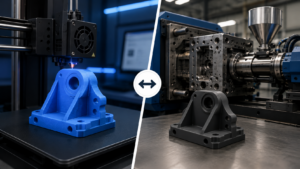
Determining the break‑even volume—the production quantity at which injection molding becomes cheaper than 3D printing—depends on material cost, part size and mold cost. A simplified approach is:
Break‑even quantity = (Mold cost) / (3D printing cost per part – injection molding cost per part)
For example, if the mold costs $10 000, and the 3D printing cost per part is $7 while the injection‑molded part cost is $2, the break‑even quantity is:
Break‑even quantity = 10 000 / (7 – 2) = 2 000 parts.
If your project requires fewer than 2 000 parts, 3D printing may be more cost‑effective. For larger volumes, injection molding’s lower per‑part cost will eventually offset the tooling expense.
Environmental impact
Additive manufacturing can reduce material waste by building only the material needed for the part, whereas injection molding may waste excess material in sprues and runners. However, injection molding can use recyclable thermoplastics more easily than some 3D printing processes. The sustainability advantages of each method depend on the specific materials and production volumes.
When to choose 3D printing
- Prototyping and design validation: Quickly iterate designs without the expense of new molds.
- Low‑ to mid‑volume production: Produce small batches with no tooling costs, and adjust designs between runs.
- Complex geometries: Create intricate features and internal channels impossible to mold.
- Customization and on‑demand manufacturing: Produce personalized parts or parts with multiple variants without retooling.
When to choose injection molding
- High‑volume production: When demand exceeds thousands of parts, per‑part savings justify the initial mold cost.
- Consistent part quality: Injection molding can produce parts with very consistent mechanical properties and surface finishes.
- Material selection: Some materials, particularly certain engineering thermoplastics and elastomers, are more commonly available for injection molding.
- Long product life cycles: For established products with stable designs, the initial tool investment spreads over many years.
Hybrid approach
Many companies use both techniques. They 3D‑print prototypes and low‑volume batches while refining the design; once demand justifies it, they invest in injection molds for high‑volume production. SNL Creative can support customers through this transition. Their design‑for‑manufacturing services help optimize parts for both processes, and their prototyping services offer quick turnaround times of 24–72 hours. When injection molding becomes viable, the company’s network of tooling partners can produce molds and continue production.
Conclusion
The choice between 3D printing and injection molding depends on quantity, budget, lead time and part complexity. Additive manufacturing eliminates tooling costs and shortens development cycles, making it ideal for prototypes and low‑volume production. Injection molding delivers low per‑part costs for high volumes but requires significant up‑front investment and longer lead times. By understanding the cost dynamics and design constraints of each process, you can choose the best manufacturing strategy for your product. SNL Creative’s expertise in both additive manufacturing and tooling support can help you navigate these decisions and scale your production efficiently.