3D Scanning at Our Studio or Your Location
SNL Creative offers 3D scanning for reverse engineering and scan-to-CAD, product development, inspection workflows, restoration, and digital preservation. Our scanning capabilities include ZEISS ATOS structured-light scanning and the portable 3DeVOK MT handheld 3D scanner. We select the scanning system and capture approach around the object, access, surface condition, and required detail.
On-Site 3D Scanning with the 3DeVOK MT
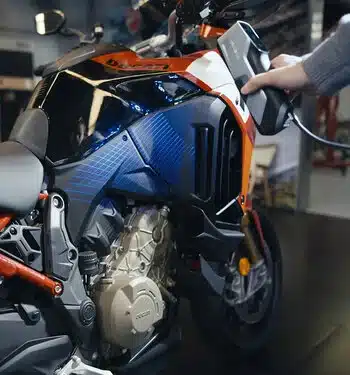
The handheld MT allows us to travel to a customer’s location and capture objects that are large, installed, difficult to transport, or better scanned where they are used. Applications include mechanical components, vehicle parts, tooling, sculptures, and other physical objects. On-site capture can reduce the need to ship or move an object; the scan still requires safe access, visible surfaces, and suitable working conditions.

Three Scanning Modes
The MT combines blue laser, infrared laser, and infrared speckle capture. Each mode serves a different capture need; mode selection depends on the object and the project requirements.
34 Blue Laser Lines
Used for detailed capture of industrial and mechanical parts, edges, and complex geometry. Blue laser capture is useful for challenging dark or reflective surfaces, with preparation assessed for each object.
22 Infrared Laser Lines
Used for detailed scanning of smaller objects and parts across a range of materials. This provides an additional laser capture option when selecting a workflow for the object’s size and surface.
Infrared Speckle
Large-area capture for larger objects, organic forms, sculptures, furniture, and body-scanning applications. Geometry or texture can support alignment where suitable features are available.
From Physical Object to Digital Data
Scanning captures the object’s visible surface as digital geometry. Typical mesh and point-cloud formats include STL, OBJ, PLY, and ASC, selected for the downstream workflow. Color and texture capture are available when relevant to the project.
A scan mesh is a reference for reverse engineering; creating an editable CAD model requires a separate modeling step. Our CAD and digital modeling support can help develop geometry for design changes, tooling, and 3D printing.
Planning an On-Site Scan
- Purpose and critical dimensions: Identify the surfaces, interfaces, tolerances, and output files needed before scanning. Inspection work requires an agreed measurement and validation approach.
- Access and coverage: The scanner needs a clear view of each surface. Hidden features, deep cavities, undersides, and assembled interfaces may require repositioning or additional capture setups.
- Surface and alignment: Reflective, transparent, dark, repetitive, or featureless surfaces may require preparation or markers. Marker-free capture is available where the chosen mode and object features support it.
- Site conditions: Review lighting, vibration, movement, workspace, and permission to access or prepare the object. Confirm whether the part can be moved or must remain installed.
- Downstream use: Discuss mesh cleanup, CAD reconstruction, inspection, and manufacturing requirements early. Achievable results depend on the object, scan setup, and verification method.
For an on-site scanning review, contact SNL Creative with photographs, approximate dimensions, location, required surfaces, and intended use of the scan.
Mode descriptions and manufacturer photographs: 3DeVOK MT product reference.
ZEISS ATOS Scanning and Project Examples
Our existing ZEISS ATOS capability complements handheld scanning for controlled surface capture and measurement workflows. Equipment selection, scan coverage, and validation are determined for each project.