Category

Uncategorized

How 3D Printing is used for Excelerated Marketing

By 3D Printing Technical Resources, Uncategorized
Marketing moves at the speed of a feed — manufacturing rarely does. 3D printing closes that gap, letting brands turn limited-edition drops, pop-up activations, and virtual concepts into physical products on a campaign timeline instead of a tooling one. No mold to cut, no long lead time to wait out — just fast iteration, small-batch runs, and finish quality good enough for the moment it’s built for.

A marketing calendar moves in days. Traditional manufacturing moves in months. That gap used to mean brands simply couldn't turn a viral concept, a limited-edition idea, or a piece of digital art into a physical product fast enough to matter. Additive manufacturing closes that gap — which is exactly why "drop" culture, pop-up activations, and virtual-to-physical collaborations have become one of the fastest-growing uses of 3D printing.

Why Traditional Production Can't Keep Up With Marketing Timelines

Injection tooling takes weeks to cut and thousands of dollars to commit to before you've made a single sellable unit. That math works for a product with a multi-year shelf life. It doesn't work for a limited-edition drop, a campaign tied to a single event, or a concept that needs to exist for exactly as long as the cultural moment does. Marketing teams increasingly need small batches, fast turnarounds, and the ability to change course after the first round of feedback — which is precisely the profile additive manufacturing is built for.

The Rise of Drop Culture

Limited-edition drops aren't a footwear-industry quirk anymore — they're a mainstream retail strategy. Luxury houses, sneaker brands, and consumer goods companies are all leaning into small-batch releases that create urgency, let a brand test an idea without overproducing, and give collectors something genuinely scarce. That model only works if production can match it: short runs, fast iteration, and finish quality high enough that "limited edition" doesn't look like a compromise.

What's Actually Changed

It's not that brands suddenly want small batches — they always have. What's changed is that additive manufacturing now makes small-batch production genuinely cost-effective and fast enough to plan a real campaign around, instead of treating it as a novelty.

Turning Virtual Products Into Physical Ones

Some of the most interesting work happening right now starts as something that was never meant to be physical at all — a digital sculpt, an album's cover art, a piece of concept design built for a screen. Bringing that into the physical world used to mean handing it to a machinist who would "clean it up" for moldability, which almost always meant losing the thing that made it interesting in the first place.

Case in Point

Totem × Jean Dawson — Glimmer of God Album Artwork

Album artwork is designed for a cover, not a mold. Translating that visual concept into a physical object means preserving the exact intent of the digital design — proportions, texture, and detail that a traditional production process would flatten out. Additive manufacturing let the physical piece stay faithful to the original artwork rather than being redesigned around what a mold could produce.

This is the pattern behind virtual-to-physical work generally: a concept exists first as a render, a sculpt, or a piece of generative design, and the manufacturing process has to be flexible enough to catch up to the creative idea instead of forcing the idea to shrink down to what conventional tooling allows.

What Makes a Marketing or Drop Project Different From Standard Manufacturing

Working on campaign-driven or drop-based production has a different rhythm than a standard production order, and a partner who only knows how to run long, predictable batches will struggle with it:

Standard Production Drop / Marketing Production
Fixed, long-lead schedule Compressed, often campaign-locked timeline
High volume, low per-unit cost focus Low volume, high finish-quality focus
Design locked well before production Design may still be evolving with creative or marketing input
Standard packaging Often needs unboxing-grade presentation and finish
Public specs and sourcing Frequently under NDA until launch day

Checklist Before You Plan a 3D-Printed Drop or Activation

  • Confirm your manufacturing partner can hold confidentiality — pre-launch drops routinely need production kept under wraps until reveal day
  • Budget for finishing, not just printing — vapor smoothing, deep dye, and hand work are what make a limited piece feel premium rather than improvised
  • Build in one iteration round — the fastest drops still benefit from a physical sample pass before committing to the full batch
  • Decide your batch size honestly — a true limited run, a pop-up-specific quantity, and a scalable product line each need a different production approach
  • Lock your timeline against the actual campaign date, not the ideal production date — and communicate that constraint upfront

Marketing doesn't wait for tooling, and increasingly it doesn't have to. Whether it's a limited-edition collectible, a pop-up-exclusive object, or a digital concept that needs to exist in someone's hands for the first time, additive manufacturing is what lets the physical product move at the same speed as the idea behind it. SNL Creative brings the same in-house design, printing, and DyeMansion finishing capability to campaign and drop work that we bring to entertainment props and collectible design — under NDA when the project calls for it.

Planning a drop, activation, or virtual-to-physical concept on a tight timeline?

Tell us the launch date first — we'll tell you what's realistic and what it takes to get there.
SNL Creatives New Facility is Now Operational!

By Manufacturing, Uncategorized

Cypress, CA – 8/15/23: SNL Creative, a leader in additive manufacturing, is thrilled to announce the inauguration of its state-of-the-art facility in Cypress, California. This facility stands as a testament to SNL Creatives’ commitment to pushing the boundaries of innovation in 3D printing and rapid prototyping, offering a diverse array of technologies and services.


Nestled in the heart of Cypress, Ca, the new facility boasts an impressive range of advanced 3D printing technologies, including Selective Laser Sintering (SLS), Stereolithography (SLA), Material Jetting, Fused Deposition Modeling (FDM), and Continuous Fiber Fabrication (CFF). This comprehensive suite of technologies empowers clients to materialize their concepts with remarkable precision and efficiency.


Diversity extends to the materials as well, with a vast selection for both prototyping and qualified materials suitable for 3D printing solutions destined for the market. SNL Creatives’ dedication to material innovation ensures that clients have access to the latest and most suitable materials for their projects.


One of the facility’s highlights is the fully dedicated Prototype Tooling department, meticulously designed to facilitate high-volume production. Complemented by a specialized hard modeling team, SNL Creatives ensures that products achieve their desired appearance and functionality before entering the mass production stage.


Moreover, SNL Creatives offers a complete paint and post-processing team, guaranteeing the creation of impeccable final appearance models that are ready to captivate and impress.


The integration of automation shines through the Virtual Portal, where clients can seamlessly upload, request quotes, and place orders. This portal seamlessly syncs with the Manufacturing Execution System (MES) software, ensuring a streamlined production process while maintaining rigorous quality control at every phase.


“We are thrilled to introduce our new Cypress facility, a testament to our relentless pursuit of excellence,” commented Shawn Zindroski COO of SNL Creative. “Our investment in cutting-edge technology, coupled with our dedicated teams, positions us to redefine additive manufacturing. We are confident this facility will elevate both our capabilities and our customers’ experience.”


SNL Creatives’ new facility in Cypress, CA, signifies a monumental step toward the future of additive manufacturing. With its impressive technologies, diverse materials, and seamless automation, the facility promises to redefine the industry landscape and set new benchmarks for innovation.


For more information and inquiries, please visit http://www.snlcreative.com.


About SNL Creative:

SNL Creative stands at the forefront of additive manufacturing, offering cutting-edge 3D printing solutions and rapid prototyping services. The new facility in Cypress, CA, embodies the company’s dedication to pushing boundaries, embracing innovation, and ensuring client satisfaction through advanced technology and expert teams.

Unlocking the Future Life-Like Prosthetics with Color 3D Printing by Stratasys

By 3d Printing Design Tips, Uncategorized

Stratasys J750 color 3D printing is unlocking the future of special effects (SFX) and stop motion animation industries with life-like prosthetics. One of the most recent advancements is introducing color 3D printing technology, particularly with the Stratasys J750 system. This groundbreaking innovation revolutionizes how artists and technicians create life-like prosthetics, intricate stop-motion animation sets, and stunning SFX elements.

The Stratasys J750 is a high-end PolyJet 3D printer, known for its ability to print in multiple materials and colors simultaneously. With over 500,000 color combinations and a wide range of material properties, the J750 empowers artists to create realistic textures, gradients, and transparencies for their projects. The printer’s layer resolution, as fine as 14 microns, enables the production of intricate and life-like details that were previously difficult or impossible to achieve with traditional methods.

Revolutionizing life-like prosthetics: the Stratasys J750 has been instrumental in advancing 3D printing for SFX and animation. Makeup artists can now design and print complex, realistic-looking prosthetic pieces, such as skin textures, wounds, or even entire facial structures, with remarkable precision. These 3D printed prosthetics not only save time and resources but also provide an unmatched level of detail, allowing filmmakers to tell stories with greater authenticity.

Transforming Stop Motion Animation: In the realm of stop motion animation, the J750 has made a significant impact by allowing animators to rapidly produce detailed, multi-colored, and textured puppets, sets, and props. The ability to print intricate and movable parts, such as facial features or limbs, has streamlined the animation process and enabled the creation of more expressive characters. The J750’s precision and versatility have opened up new creative possibilities, pushing the boundaries of what can be achieved in stop motion animation.

Special Effects Breakthroughs: Beyond prosthetics and animation, the J750 is also redefining the SFX industry by enabling artists to print realistic props, such as weapons, vehicles, or even entire miniature sets, in stunning detail. The technology’s ability to produce vibrant, multi-material prints has made it an invaluable asset for creating captivating visual effects that captivate audiences.

Conclusion: The Stratasys J750 color 3D printing system is truly revolutionizing the special effects, life-like prosthetics, and stop motion animation industries. By offering unprecedented levels of detail, color, and material versatility, the J750 is enabling artists and technicians to push the boundaries of their creativity and bring their visions to life like never before.

SNL Creative’s Mobile 3D Scanning for BTS and Line Friends

By Entertainement, Uncategorized

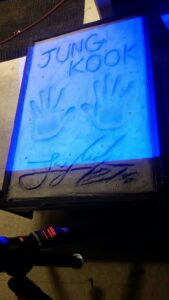
At SNL Creative, we recently worked with Line Friends to capture BTS hand and signature impressions tiles for their new pop-up store in Los Angeles. Using our ATOS photogrammetry mobile 3D scanning technology, we captured accurate 3D data of the hand print tiles, which were then used to create a stunning and immersive experience for fans of the popular K-pop group.

3d scanningLine Friends is a global character brand that creates and distributes various products featuring popular characters including BTS. For their new pop-up store in Los Angeles, Line Friends wanted to create a unique and interactive experience for BTS fans, and they enlisted our services to help bring their vision to life.

Using our mobile 3D scanning technology, we captured accurate 3D data of the BTS hand print tiles. Our team worked quickly and efficiently, ensuring that we captured high-quality data while minimizing any disruption to the store. Once the data was captured, we processed it using our specialized software to create a 3D model of the hand-print tiles.

The 3D model was then used to create an immersive experience for fans of BTS. Visitors to the pop-up store can view the 3D Printed model of the hand print tiles in stunning detail, allowing them to feel like they were right there with the BTS members.

At SNL Creative, we are proud to have been a part of such an exciting project. Our mobile 3D scanning technology allowed us to capture accurate data quickly and efficiently, and our post-processing services ensured that the data was clean and ready for use for the  Fans experience. We look forward to working with Line Friends and other clients in the future to create innovative and immersive experiences for their customers.

Automotive 3d printing

By Automotive, Uncategorized

Automotive 3D Printing – SNL Creative – Los Angeles

Additive manufacturing, or 3D printing, has been a game-changer for the automotive industry in recent years. From the design stage to production and beyond, 3D printing has proven to be a valuable tool for professionals at all automotive design and manufacturing levels.

One area where 3D printing has been beneficial is lightweight. By using 3D printing to create complex geometries and lattice structures, manufacturers can reduce the weight of parts without sacrificing strength or durability. This not only helps to improve fuel efficiency but also helps to reduce emissions, making vehicles more environmentally friendly.

Another key benefit of 3D printing is part consolidation. By combining multiple parts into a single printed component, manufacturers can simplify their supply chains and reduce production costs. This is particularly useful for low-volume production runs or for custom parts that would otherwise require costly tooling.

Work holding and tooling are also areas where 3D printing can benefit significantly. Manufacturers can improve their production processes and reduce lead times by using 3D printing to create custom jigs, fixtures, and tooling. 3D printed tools can also be easily modified or replaced as needed, which helps to minimize downtime and increase overall efficiency.

Customization is another area where 3D printing excels. By using 3D printing to create bespoke parts or components, manufacturers can offer greater flexibility to their customers. This is particularly useful for the automotive aftermarket, where customers may be looking for unique or hard-to-find parts.

Finally, 3D printing is a valuable tool for creating vehicle color, material, and finish (CMF) options. By using 3D printing to create prototypes and test different CMF combinations, designers can quickly arrive at the perfect solution. This saves time and money and helps ensure that vehicles are visually appealing and exciting for consumers.

In conclusion, additive manufacturing is revolutionizing the automotive industry in various ways. From lightweight to part consolidation, work holding to customization, and CMF design, 3D printing is providing automotive professionals with new tools and possibilities. As the technology continues to improve, it’s exciting to think about the ways in which it will continue to transform the industry in the years to come. Whether you’re a designer, engineer, or production line worker, it’s important to understand the potential of additive manufacturing and how it can help you achieve your goals.