3D Printing, CAD Design & 3D Scanning FAQ | SNL Creative – Orange County, CA
Get a Quote

Knowledge Base · Orange County, CA

3D Printing, CAD Design
& 3D Scanning FAQ

Everything you need to know about SNL Creative’s industrial 3D printing, CAD design, 3D scanning, reverse engineering, post-processing, and design-to-production services.

SLS SLA FDM PolyJet MJF CFF CAD Design 3D Scanning Reverse Engineering Vapor Smoothing Deep Dye Urethane Casting
Q01 What manufacturing services does SNL Creative provide? +

SNL Creative is a high-capacity design-to-manufacturing studio based in Orange County, CA. We provide a comprehensive all-under-one-roof workflow from initial concept and CAD modeling through prototyping, 3D scanning, reverse engineering, short-run production, finishing, and assembly.

  • Industrial 3D Printing: SLS, MJF, PolyJet, FDM/FFF, SLA, and CFF.
  • CAD Design Services: Product design, file modification, design-for-manufacturing, and production file preparation using Rhino3D, Fusion 360, and OnShape.
  • 3D Scanning: Physical part capture, scan-to-CAD, reverse engineering, mold capture, fit verification, and digital archiving.
  • Specialized Additive Manufacturing: TPU 1301 lattice printing, Digital Foam, and continuous fiber reinforcement.
  • Traditional & Hybrid Manufacturing: Silicone molding, urethane casting, and multi-component assembly.
  • Advanced Finishing: Vapor smoothing, deep-dye coloring, bead blasting, sanding, polishing, clear coating, and custom painting.
Industries served: Automotive, fashion & footwear, medical devices, consumer goods, robotics, drones, defense & aerospace, electric vehicles, film, entertainment, and licensed products.
Q02 Can you take my project from prototype to final product? +

Yes. SNL Creative specializes in prototype-to-production transitions. We help customers move from idea, sketch, physical sample, CAD file, or early prototype into a manufacturable part or product.

1
Discovery & File ReviewWe review the product goal, part function, material requirements, timeline, and available files or physical samples.
2
CAD, Scanning & Engineering SupportWe create, modify, scan, or reverse engineer geometry so the part is ready for manufacturing.
3
Prototype & ValidationWe produce first articles to check fit, form, function, finish, assembly, and customer approval.
4
Production & FinishingWe support short-run manufacturing, finishing, inspection, assembly, and delivery from our Orange County facility.
Q03 Why choose SNL Creative for low-volume manufacturing? +

SNL Creative fills the gap between one-off prototypes and high-volume injection molding. We are not just a print farm — we are a design, engineering, and manufacturing partner.

  • No expensive tooling required: 3D printing can eliminate mold tooling costs for many low-to-mid volume programs.
  • Design support included: Our CAD and DFM process helps solve issues before production starts.
  • U.S.-based supply chain: Work is supported from our Orange County, California facility.
  • Multiple manufacturing paths: 3D printing, scanning, CAD, finishing, casting, and assembly under one roof.
  • Production-ready finishing: Vapor smoothing, dye coloring, paint, clear coat, and assembly are available after printing.
Q04 What are your typical turnaround times? +
Standard Prototypes
24–72 hours when project-ready files are supplied
CAD Modifications
Varies by complexity and design scope
3D Scanning
Scheduled based on part size, scan detail, and deliverables
Small Batch Production
Typically 3–10 business days after file approval
Urethane Casting
Typically 7–14 business days
Expedited Services
Available — contact us
Rush orders welcome. Expedited services may be available for deadline-critical engineering, film, aerospace, robotics, and consumer product projects.
Q05 Does SNL Creative offer CAD design and product development services? +

Yes. SNL Creative provides CAD design, product development, design modification, and design-for-manufacturing support for customers who need help turning an idea, sketch, physical sample, scan, or early concept into a manufacturable digital model.

Our CAD services are built around practical manufacturing outcomes. The goal is not just to make a file that looks good on screen — the goal is to create a model that can be quoted, prototyped, tested, finished, assembled, and produced.

  • Concept-to-CAD development: Turn sketches, images, rough ideas, or product requirements into usable 3D models.
  • Product design refinement: Improve shape, ergonomics, usability, wall thickness, assembly features, and manufacturing feasibility.
  • Design for 3D printing: Optimize parts for SLS, SLA, FDM, PolyJet, MJF, TPU lattice, and production 3D printing.
  • Mechanical design support: Create housings, brackets, fixtures, covers, inserts, snap fits, alignment features, and functional assemblies.
  • Production file preparation: Clean, repair, modify, or convert CAD files for quoting, prototyping, or manufacturing.
Best fit: CAD design services are ideal for startups, engineers, product developers, artists, inventors, robotics companies, medical device teams, and consumer product brands that need a practical path from idea to finished part.
Q06 What CAD tools does SNL Creative use? +

SNL Creative uses a flexible CAD workflow depending on the project type, geometry, and manufacturing goal. Our main CAD tools include Rhino3D, Fusion 360, and OnShape.

CAD Tool Best Use Common Applications
Rhino3D Complex surfaces, organic forms, product shapes, and design refinement Consumer products, sculptural models, footwear, packaging, display models, and complex surface work
Fusion 360 Mechanical design, assemblies, part modification, and manufacturing-focused CAD Fixtures, brackets, housings, adapters, prototypes, assemblies, and functional components
OnShape Cloud-based CAD collaboration, version control, and engineering workflows Collaborative product development, part revisions, customer design review, and production file management
Practical CAD approach: We select the design tool based on what the project needs — clean engineering geometry, complex surfaces, collaborative review, or fast manufacturing preparation.
Q07 What types of CAD files can you work with? +

SNL Creative can work with a wide range of engineering, design, scan, and 3D printing file formats. For production work, we typically prefer STEP files because they preserve clean CAD geometry and make it easier to inspect, modify, and prepare parts for manufacturing.

File Type Best Use Notes
STEP / STP Engineering CAD Preferred for functional parts, assemblies, and design modifications
STL 3D printing mesh files Good for quoting and printing, but harder to edit cleanly
OBJ Scans, color models, sculpted geometry Useful for 3D scanning, full-color models, and organic surfaces
3MF 3D printing with color/material data Helpful for PolyJet, color files, and advanced print preparation
IGES Surface CAD Useful for older CAD workflows and surface-based models
Native CAD Files Design review and editing Rhino3D, Fusion 360, and OnShape workflows can be reviewed when appropriate
Recommendation: If your part needs to be modified, assembled, inspected, or manufactured with tight features, send a STEP file whenever possible.
Q08 Can you modify or repair existing 3D files? +

Yes. Many customer files require cleanup before they are ready for quoting, printing, finishing, or production. SNL Creative can review and repair files that have thin walls, non-manifold geometry, missing surfaces, poor mesh quality, incorrect scale, unsupported features, or geometry that is not optimized for the selected process.

  • File repair: Fix holes, inverted normals, open edges, non-manifold mesh errors, and broken surfaces.
  • Wall thickness adjustments: Modify thin features so they are printable and durable.
  • Scale correction: Confirm units, dimensions, and intended final part size.
  • Assembly adjustments: Add clearances, alignment features, tabs, bosses, inserts, and hardware locations.
  • Cost optimization: Hollow parts, reduce material volume, improve nesting, or adjust geometry for more efficient production.
  • Process optimization: Modify geometry for SLS, SLA, FDM, PolyJet, MJF, urethane casting, or finishing requirements.
Production advantage: File cleanup before manufacturing helps reduce failed prints, unexpected costs, poor fit, weak features, and delays during production.
Q09 Do you offer design for additive manufacturing? +

Yes. Design for additive manufacturing is one of the most important steps in getting the best performance and value from 3D printing. A part designed for machining, molding, or traditional fabrication is not always optimized for 3D printing.

SNL Creative helps customers redesign or improve parts so they take advantage of the strengths of 3D printing, including complex geometry, reduced assemblies, lightweight structures, lattice features, internal channels, part consolidation, and short-run production without tooling.

1
Review the ApplicationWe look at the part’s function, environment, loads, fit requirements, finish needs, and production goals.
2
Select the Right ProcessWe help determine whether SLS, SLA, FDM, PolyJet, MJF, TPU lattice, or casting is the right path.
3
Optimize the GeometryWe adjust wall thickness, clearances, support strategy, orientation, material use, and production features.
4
Prepare for ManufacturingWe finalize the file for prototyping, production, finishing, assembly, and inspection.
Q10 Does SNL Creative offer 3D scanning services? +

Yes. SNL Creative offers 3D scanning services for customers who need to capture physical parts, legacy components, handmade models, tooling, molds, prototypes, or products that do not already have usable digital CAD data.

3D scanning is useful when you need to recreate a part, verify a shape, build a digital archive, compare a physical part to CAD, or use a real-world object as the starting point for a new design.

  • Physical part capture: Convert real-world parts into digital scan data.
  • Reverse engineering: Use scan data to recreate or rebuild usable CAD geometry.
  • Scan-to-CAD workflows: Develop CAD models from existing parts or physical samples.
  • Mold and tooling capture: Digitize molds, tools, patterns, and legacy production assets.
  • Fit and assembly checks: Capture geometry for comparison, alignment, and product development.
  • Digital archiving: Preserve physical products, molds, artwork, or production assets as digital files.
Common use case: Customers often bring us an existing product, broken part, handmade model, or old component and ask us to scan it, modify it, and prepare it for 3D printing or manufacturing.
Q11 What can 3D scanning be used for? +

3D scanning is valuable across product development, manufacturing, restoration, quality review, and digital asset creation. It gives teams a practical way to capture complex geometry that would be difficult or time-consuming to measure by hand.

Application What It Helps With Typical Output
Reverse Engineering Recreating a part when no CAD exists Scan mesh, reference model, or rebuilt CAD
Product Development Using a physical sample as the starting point for a new design Scan data, modified geometry, production-ready CAD
Fit Verification Checking how parts align, mate, or assemble Scan overlay, dimensional comparison, CAD adjustment
Mold Capture Digitizing molds, tooling, and legacy production assets Digital archive, scan mesh, reverse-engineered surfaces
Artwork and Sculptural Forms Capturing organic shapes, handmade models, or sculpted parts OBJ, STL, or modified digital model
Manufacturing Support Comparing physical parts to CAD or preparing replacement parts Inspection reference, modified CAD, print-ready model
Q12 What file types can be delivered from 3D scanning? +

The deliverable depends on what you need to do next. Some projects only require a scan mesh for visualization or 3D printing, while others require reverse engineering and CAD rebuilding for future manufacturing or design changes.

Deliverable Best For Notes
STL 3D printing and basic mesh workflows Good for single-color 3D printing and simple physical capture
OBJ Textured scans, organic models, and visual workflows Useful for models where surface detail or color texture matters
STEP / STP Manufacturing CAD and engineering changes Requires reverse engineering or CAD rebuilding from scan data
Reference Scan Data Fit checks and comparison to existing CAD Used to guide design changes and dimensional review
Important note: A scan mesh is not always the same as clean CAD. If you need a file that can be easily edited, dimensioned, or manufactured repeatedly, a scan-to-CAD or reverse-engineering step may be required.
Q13 Can you scan a part and then 3D print it? +

Yes. SNL Creative can support a complete scan-to-print workflow. This is helpful when a customer has a physical part but does not have a usable digital file.

1
Scan the Physical PartWe capture the part geometry and create a digital reference model.
2
Clean or Rebuild the FileWe repair the mesh or rebuild CAD depending on the required accuracy and end use.
3
Modify for ManufacturingWe adjust wall thickness, scale, clearances, and features for the selected 3D printing process.
4
Print, Finish & DeliverWe produce the part using the right material and finish for the application.
Good candidates: Replacement parts, vintage components, custom-fit parts, sculpted models, tooling patterns, production samples, and products that need design updates.
Q14 What core 3D printing technologies does SNL Creative operate? +

We operate a multi-platform facility with hardware across multiple 3D printing technologies, helping match each part to the correct process, material, and finish.

Technology Platform Best For
SLSEOS P396Functional end-use parts, complex geometry, no supports, PA2200, and TPU 1301
SLAStratasys Neo 450High-detail visual models, master patterns, clear parts, and smooth surface finish
FDM IndustrialStratasys Fortus 450mcEngineering-grade materials, jigs, fixtures, tooling, and structural parts
FDM High-SpeedBambu LabRapid iteration prototypes and production support
PolyJetStratasys J750Full color, multi-material, high-detail models, and realistic prototypes
MJFHP Multi Jet FusionProduction nylon parts and consistent batches
CFFMarkforgedCarbon fiber, Kevlar, and fiberglass-reinforced parts
Q15 What is SLS printing and what materials can you run? +

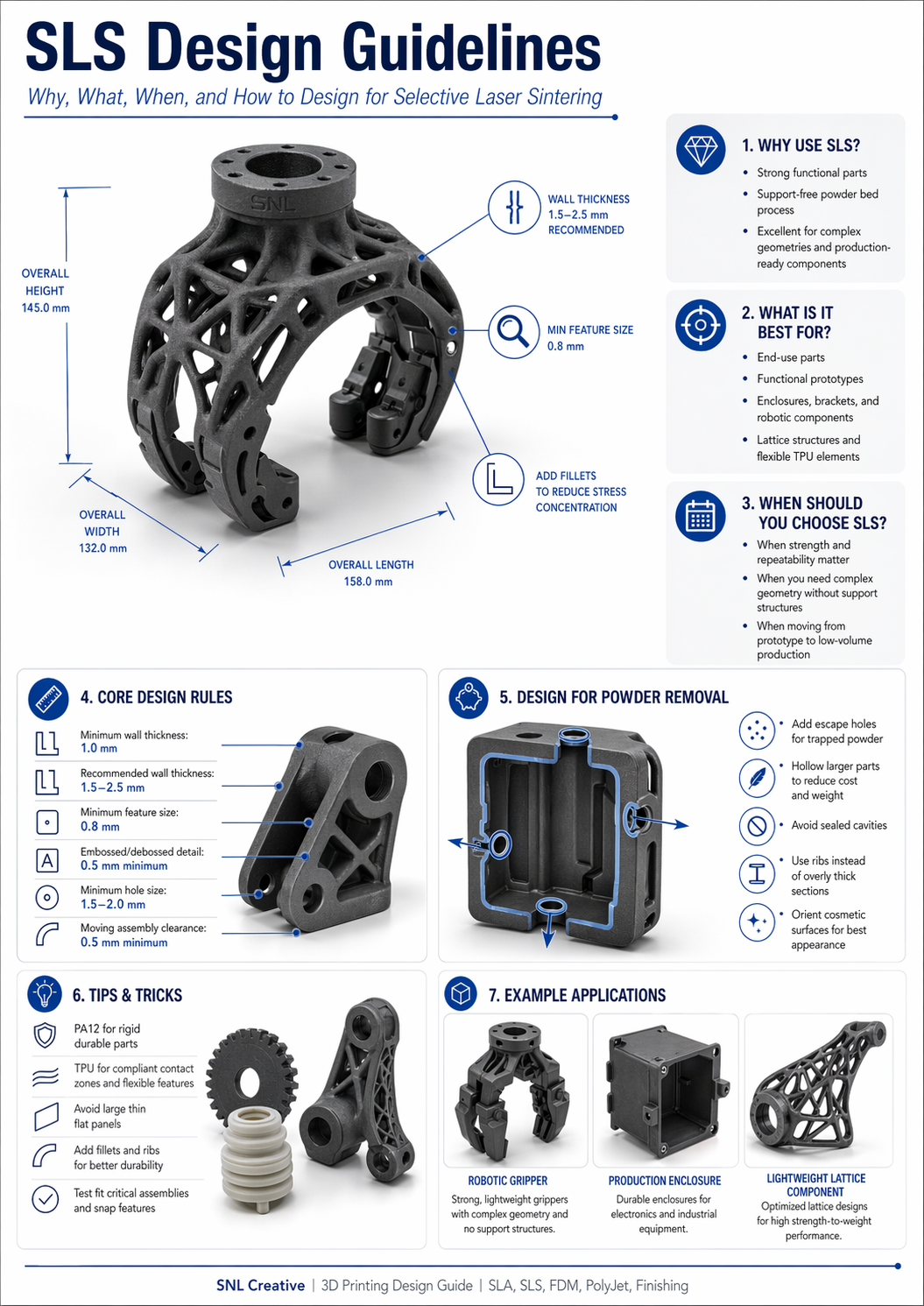
Selective Laser Sintering uses a laser to fuse polymer powder into durable parts. Because the surrounding powder supports the geometry, SLS is ideal for complex parts, nested builds, internal channels, functional prototypes, and short-run production components.

SNL Creative currently offers PA2200 Nylon 12 and TPU 1301 for SLS production.

Material Properties Applications
PA2200 Nylon 12 Strong, durable, chemical-resistant, and well-suited for functional parts Housings, brackets, connectors, fixtures, functional prototypes, and short-run production parts
TPU 1301 Flexible, elastic, energy-absorbing, and ideal for lattice structures Digital Foam, footwear midsoles, protective padding, vibration isolation, ergonomic grips, and robot skins
SLS advantage: Parts can nest in X, Y, and Z within the build volume, making SLS cost-effective for functional production runs in PA2200 Nylon 12 and flexible TPU 1301.
Q16 What is SLA printing and what materials can you run? +

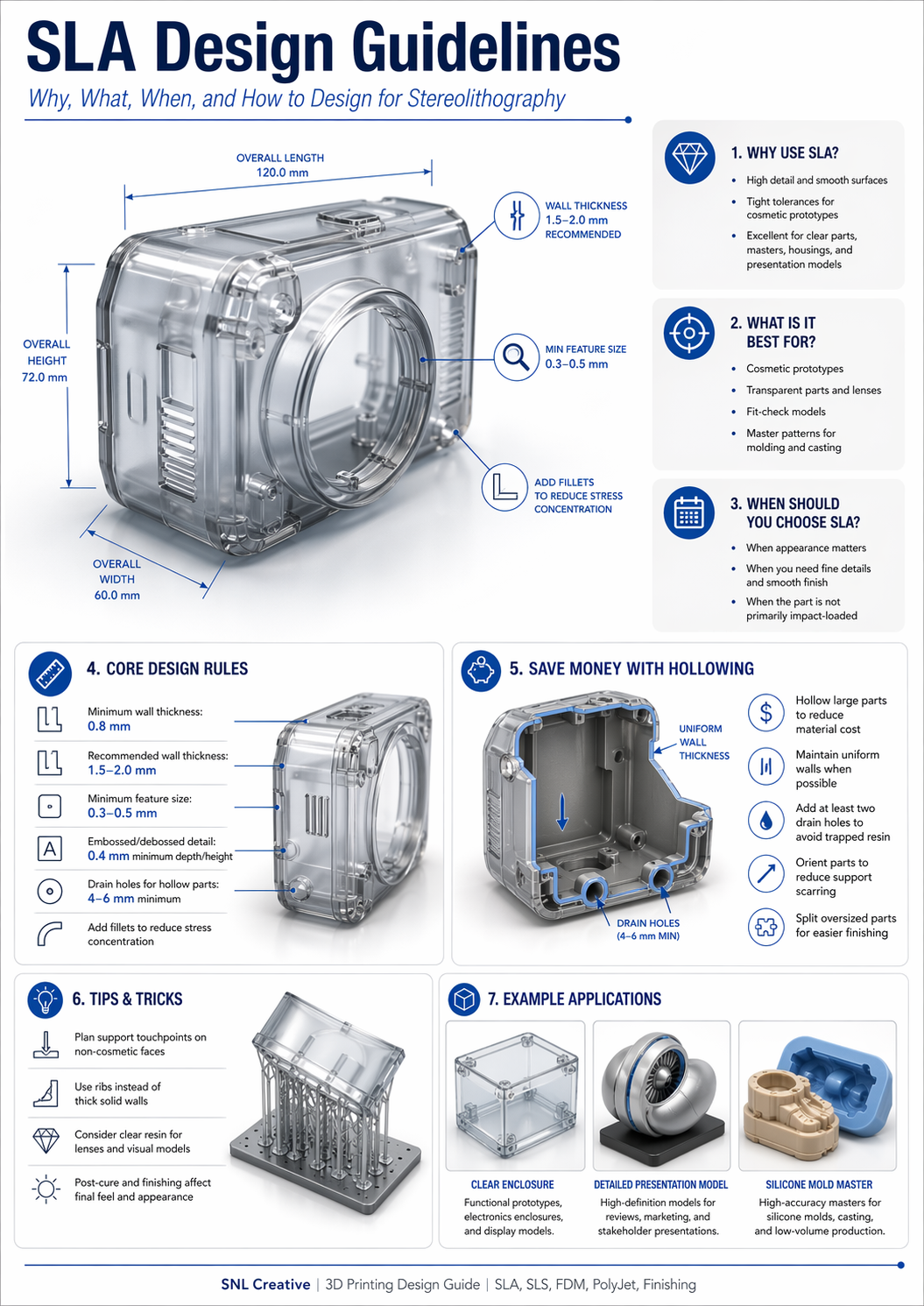
SLA uses a UV laser to cure liquid resin with exceptional detail and surface finish. It is ideal for visual models, master patterns, clear parts, presentation prototypes, and high-detail consumer products.

Material Properties Applications
Standard ResinHigh detail and smooth surface finishVisual prototypes and concept models
Tough ResinABS-like toughnessFunctional prototypes and enclosures
Clear ResinPolishable transparencyLenses, covers, fluid visualization, and clear prototypes
High-Temperature ResinElevated heat resistanceTooling inserts and high-temp prototypes
Flexible ResinRubber-like feelGrips, gaskets, and flexible mockups
Pro tip: SLA parts require supports. Place cosmetic faces away from the support side when possible to reduce visible witness marks.
Q17 What is FDM printing and what materials can you run? +

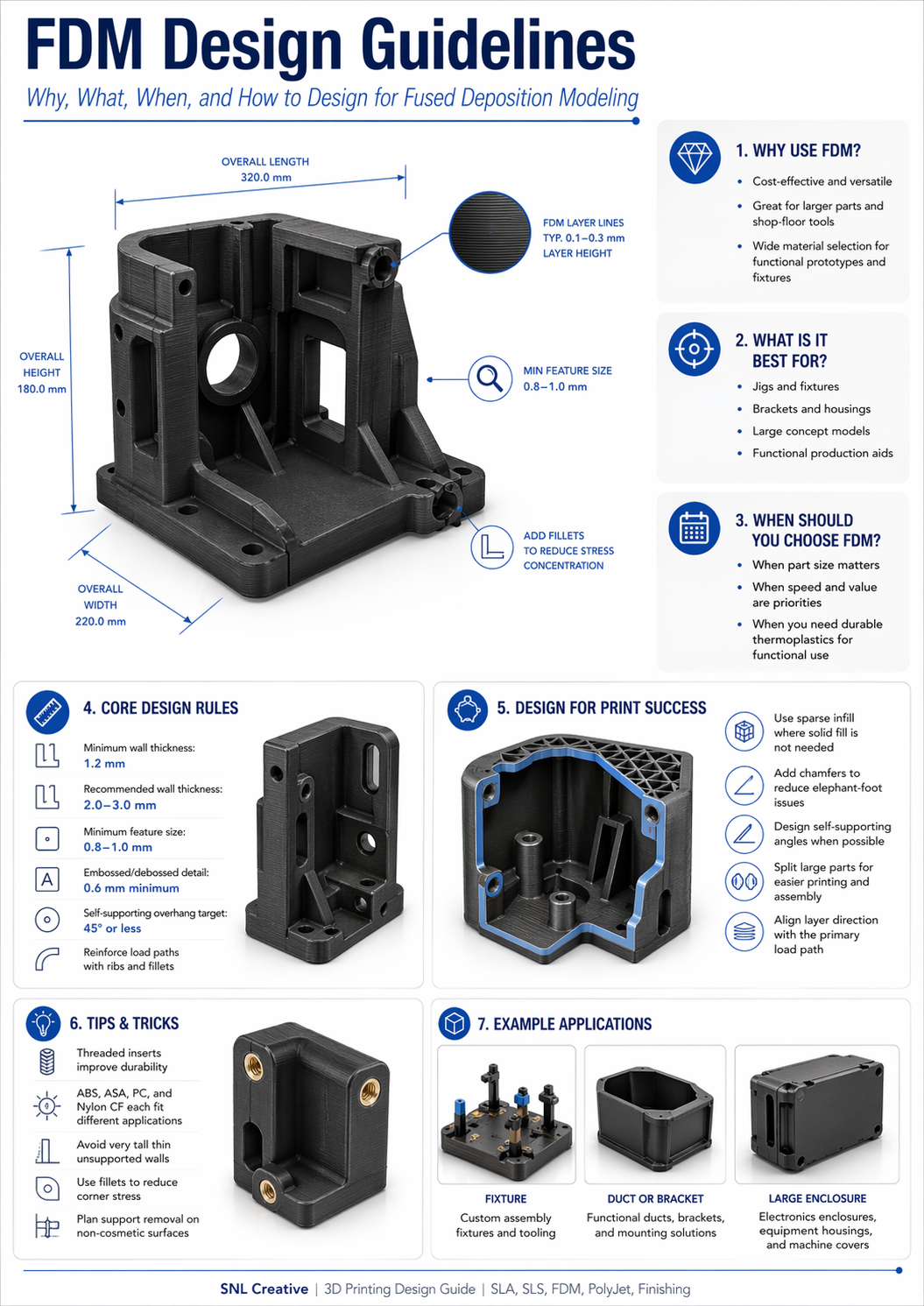
FDM extrudes thermoplastic filament layer by layer. SNL Creative uses industrial FDM systems for engineering materials and high-speed FDM platforms for rapid iteration and production support.

Material Properties Applications
ABS / ASATough, durable, with UV-stable optionsFunctional prototypes and outdoor parts
PC / PC-ABSImpact-resistant and engineering-gradeEnclosures, fixtures, and automotive parts
Nylon 12CFCarbon-fiber-filled nylonLightweight structural parts and tooling
PLA / PETGFast and cost-effectiveConcept models and quick-turn prototypes
TPUFlexible and abrasion-resistantGrips, gaskets, protective covers, and soft-touch prototypes
Q18 What is PolyJet and what can it do with color and multi-material? +

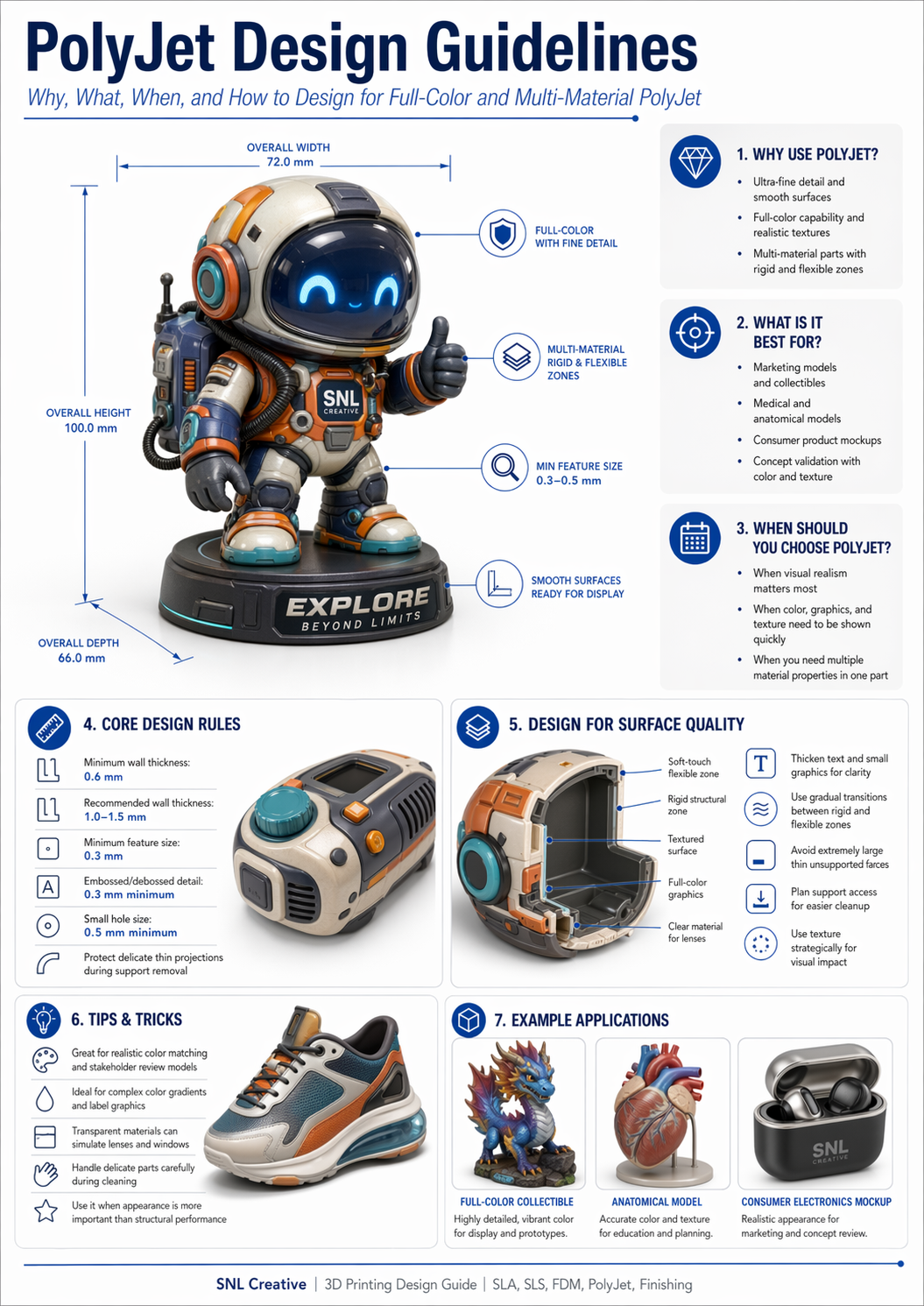
PolyJet jets photopolymer droplets and cures them with UV light. It can produce full-color parts, multi-material prototypes, transparent sections, flexible areas, and high-detail cosmetic models.

Material Properties Applications
VeroUltraRigid full-color materialColor prototypes, collectibles, product models, and medical models
Agilus30Flexible rubber-like materialGaskets, grips, overmolded prototypes, and wearables
Digital ABSTough, ABS-like performanceSnap fits, housings, and functional assemblies
Transparent MaterialsClear and tintableBottles, lenses, covers, and fluid visualization
Color capability: PolyJet is ideal for presentation models, product samples, medical models, collectibles, and realistic full-color prototypes.
Q19 What is MJF and when should I use it? +

Multi Jet Fusion uses fusing and detailing agents across a nylon powder bed. MJF is a strong fit for production nylon parts, consistent mechanical properties, and repeatable short-run manufacturing.

Primary Material
PA12 Nylon
Typical Accuracy
±0.2mm
Natural Color
Gray
Supports Required
None
MJF vs. SLS: Use MJF for high-volume nylon production. Use SLS at SNL Creative when your project requires PA2200 Nylon 12 or flexible TPU 1301 parts.
Q20 What is CFF and what does Black Aluminum mean? +

Continuous Fiber Reinforcement inlays carbon fiber, fiberglass, or Kevlar into a nylon matrix. This creates lightweight parts with strong strength-to-weight ratios, often used as a replacement for machined aluminum in certain tooling and structural applications.

Fiber Properties Applications
Carbon FiberHighest stiffnessBrackets, drone frames, robotic arms, and tooling
KevlarImpact-absorbingProtection, wear parts, and safety equipment
FiberglassCost-effective stiffnessGeneral reinforcement and fixtures
HSHT FiberglassHigh-strength, high-temperatureHigh-temp tooling and automotive parts
Q21 What is Digital Foam and how does SNL Creative use it? +

Digital Foam refers to 3D-printed TPU lattice structures that mimic traditional foam while offering engineered, tunable mechanical behavior. Lattice density, cell size, and stiffness can be adjusted across the part.

  • Footwear midsoles: Zoned cushioning and performance comfort.
  • Helmet padding: Energy management and impact absorption.
  • Ergonomic grips: Tunable compression and comfort.
  • Drone protection: Lightweight vibration isolation.
  • Robot skins: Flexible, impact-absorbing shells and pads.
  • Medical padding: Patient-specific comfort and support.
Engineering support included: We help evaluate lattice geometry, manufacturability, production readiness, and post-processing options.
Q22 What is vapor smoothing? +

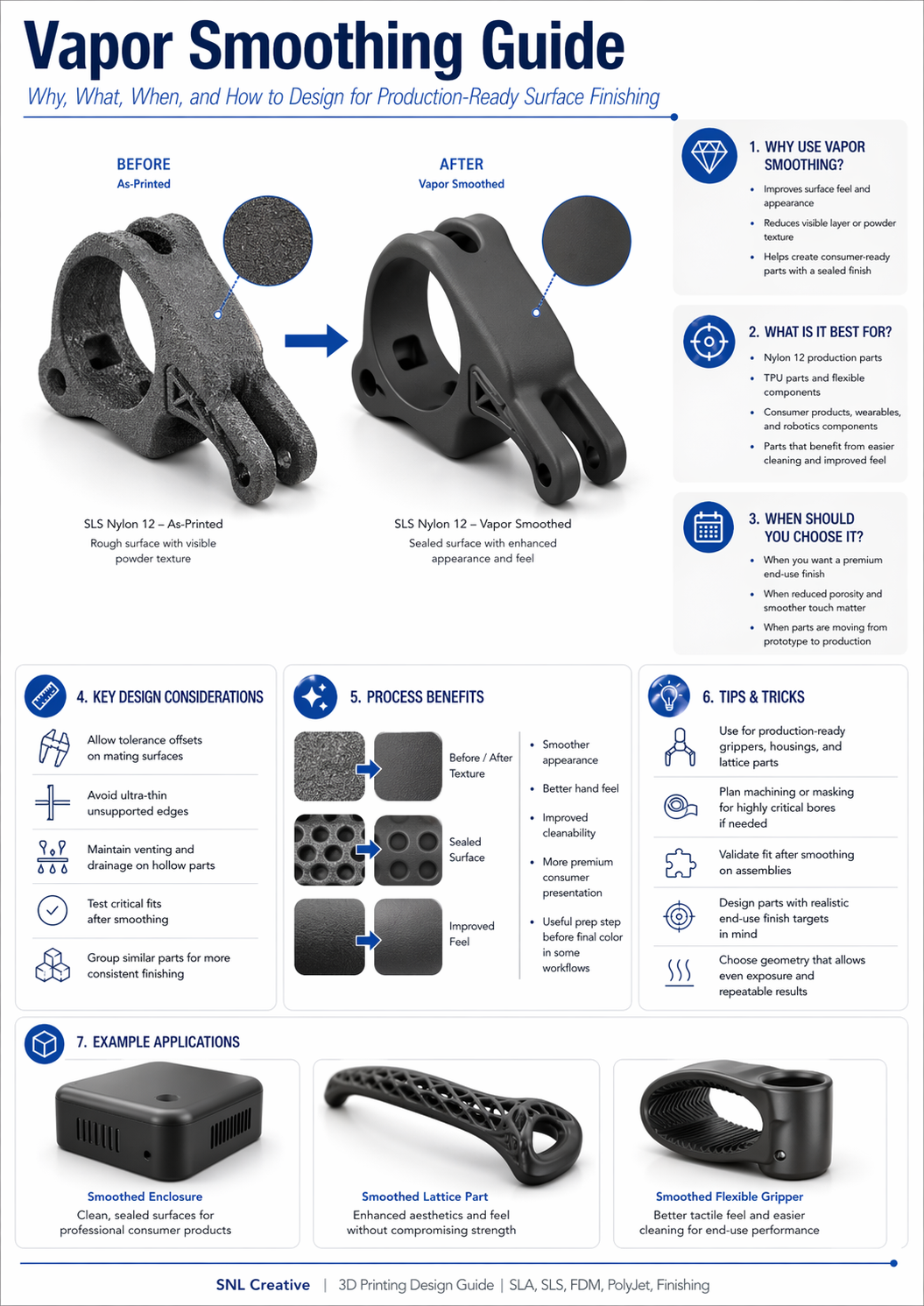
Vapor smoothing uses controlled chemical vapor to reduce surface roughness and seal porous polymer surfaces. It improves the look, feel, cleanability, and finish quality of SLS and MJF nylon parts.

Surface Finish
Smoother production-grade feel
Compatible Materials
PA12, PA2200, and select powder-bed materials
Typical Use
End-use production parts
Lead Time
Often 1–2 days after print
Tolerance note: Vapor smoothing can slightly affect dimensions. Critical fits should be reviewed before production.
Q23 What is deep dye coloring? +

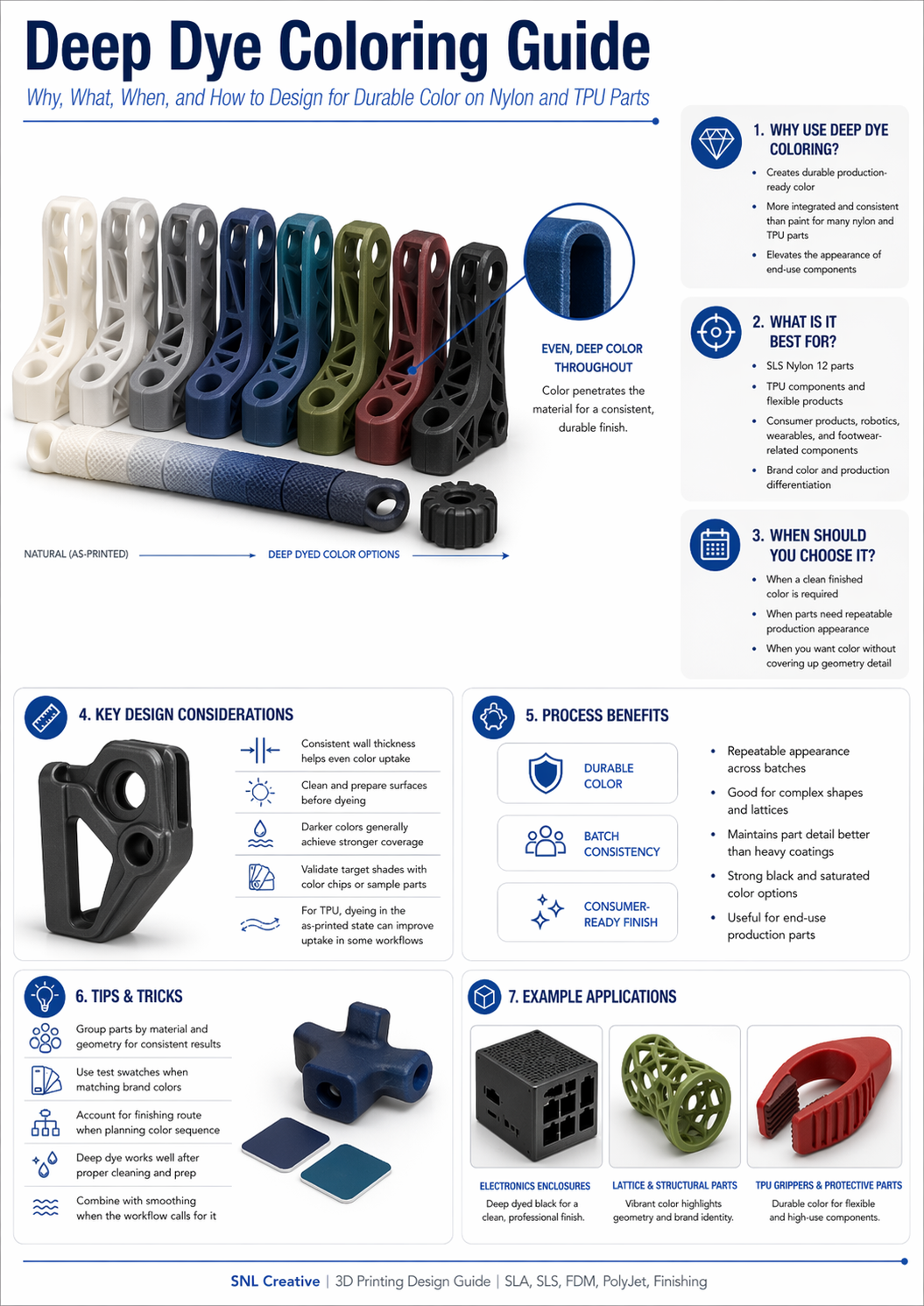
Deep dye coloring uses heat and dye chemistry to penetrate the surface of nylon parts. Unlike paint, dye becomes part of the outer material surface and cannot peel or chip like a coating.

Color Type Use Case Notes
BlackProduction partsMost consistent and durable option
Dark ColorsBrand and product colorwaysGood saturation on nylon
Medium ColorsConsumer product finishesBest with surface preparation
Custom ColorBrand-specific workDevelopment may be required
Production finish: Vapor smoothing and dye coloring are often combined for finished, market-ready 3D printed products.
Q24 What other finishing and post-processing options are available? +
  • Bead blasting: Uniform matte finish for SLS and MJF parts.
  • Custom painting: Color, texture, gloss, matte, and specialty coatings.
  • Clear coat: Added gloss, UV protection, and surface protection.
  • Sanding and polishing: Common for SLA and clear components.
  • Support removal: For FDM, SLA, and PolyJet parts.
  • Heat-set inserts: Threaded brass inserts for functional assemblies.
  • Assembly and bonding: Multi-part assemblies and adhesive bonding.
  • Inspection: First-article inspection and dimensional reporting available.
Q25 Do you offer urethane casting and silicone molding? +

Yes. For short-run production, silicone molding and urethane casting can bridge the gap between 3D printing and injection molding. This is useful for market validation, limited production, flexible parts, rigid housings, production-like samples, and parts that require cast urethane material properties.

Typical Quantity
25–100+ parts
Mold Lead Time
7–14 business days
Material Range
Soft rubber-like to rigid plastic-like
Capabilities
Color, inserts, texture, assembly

Ready to Move from
Idea, Scan, or CAD to Production?

Talk to our engineering team about your 3D printing, CAD design, 3D scanning, or manufacturing project. We review every file before quoting — no commitment required.

Talk to Our Experts Get an Instant Quote

© 2025 SNL Creative — Orange County, CA  |  Industrial 3D Printing, CAD Design & 3D Scanning  |  Contact Us