
3D printing production powered by our Bambu Lab print farm.
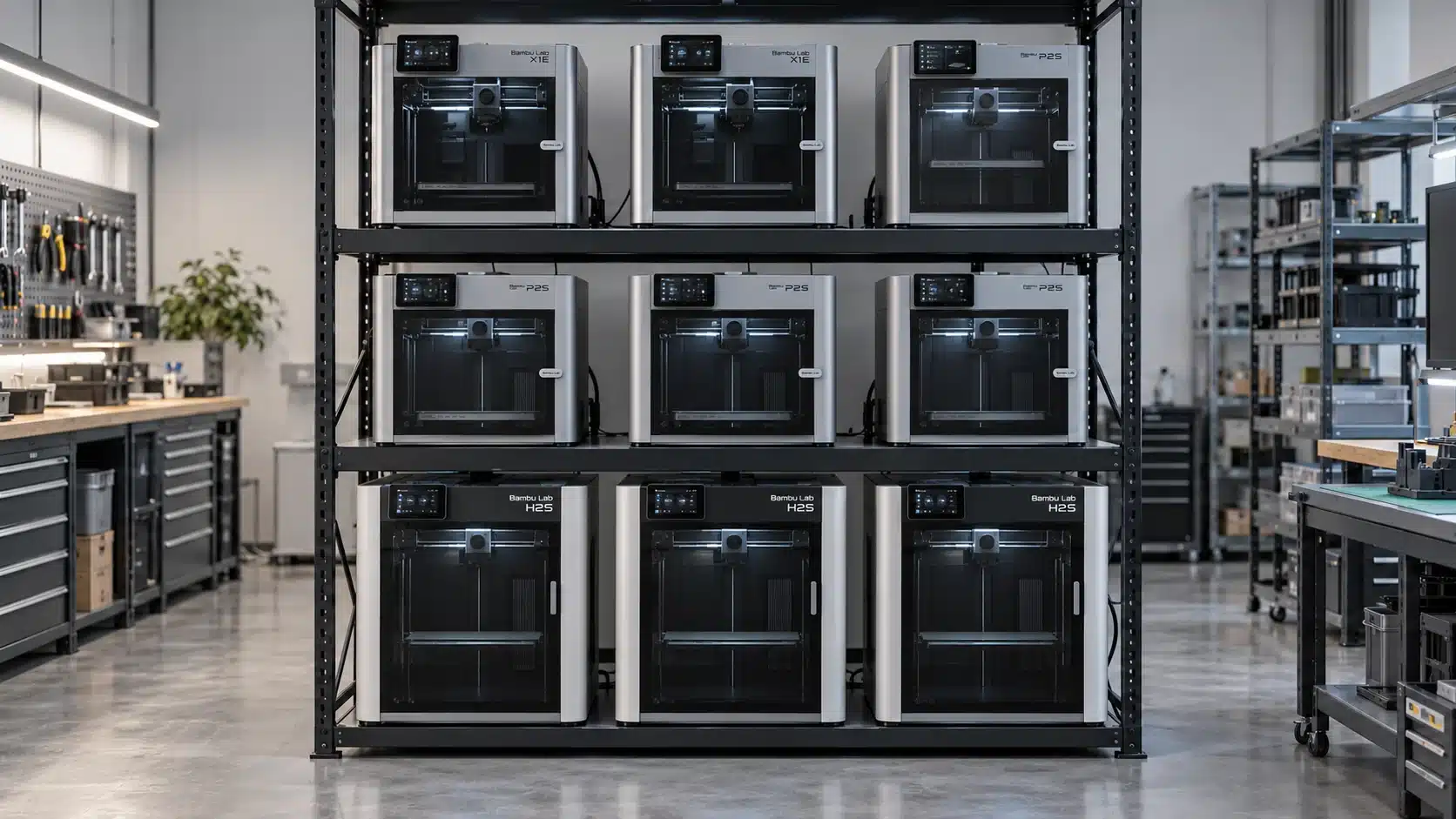
Scale your next batch with SNL Creative’s 15-printer Bambu Lab farm in Cypress, California—supporting low-volume manufacturing, repeat orders and production tooling.
Our 2 X1E, 10 P2S and 3 H2S machines give us the flexibility to plan production around your part size, material and quantity. Bring us your design and production requirements; we’ll help scope the path from an initial sample to a repeatable batch.
What does our Bambu Lab print farm offer?
SNL Creative provides production FDM 3D printing in Cypress, Orange County, California. Our fleet includes 2 Bambu Lab X1E, 10 P2S and 3 H2S printers. We configure each part for its intended use and produce first articles for customer approval before launching production.
Typical infill is 15–20%, with solid infill up to a 100% slicer setting where required. Material sourcing includes Fiberon by Polymaker and 3DXTech. Color models are limited to four colors and require .3mf files, with applied colors or supplied art direction; additional setup costs may apply.
Good production starts before the first print.
SNL Creative provides Bambu Lab FDM 3D printing for product development, production tooling and low-volume manufacturing. FDM builds parts layer by layer from thermoplastic filament, making it a practical option for many prototypes and functional components without dedicated mold tooling.
Our team brings additive manufacturing experience dating back to 2008, with capabilities across FDM, SLA, SLS, Color PolyJet and continuous carbon fiber printing. That broader perspective helps us assess whether Bambu Lab printing is the right fit for your part—and identify another process when surface finish, geometry or performance calls for it.
For production work, the conversation starts with the application: how the part will be used, what needs to fit, how many you need and what a successful result looks like.
Our Bambu Lab production fleet: X1E, P2S and H2S
Our fleet combines standard-size enclosed printers with larger-format machines, giving us options for part size, material requirements and batch scheduling.
| Platform | Fleet | Nominal build volume | Project fit |
|---|---|---|---|
| Bambu Lab X1E | 2 machines | 256 × 256 × 256 mm | Functional prototypes and engineering-material projects that benefit from active chamber heating. |
| Bambu Lab P2S | 10 machines | 256 × 256 × 256 mm | Everyday prototyping, fixtures and repeat batches across multiple machines. |
| Bambu Lab H2S | 3 machines | 340 × 320 × 340 mm | Larger prototypes, tooling and engineering applications suited to its heated chamber. |
Build volumes are manufacturer specifications. Usable space depends on orientation, supports and print setup. Fleet size does not guarantee a particular daily output or delivery date; capacity is assessed for each order.
Production parts, tooling and functional prototypes
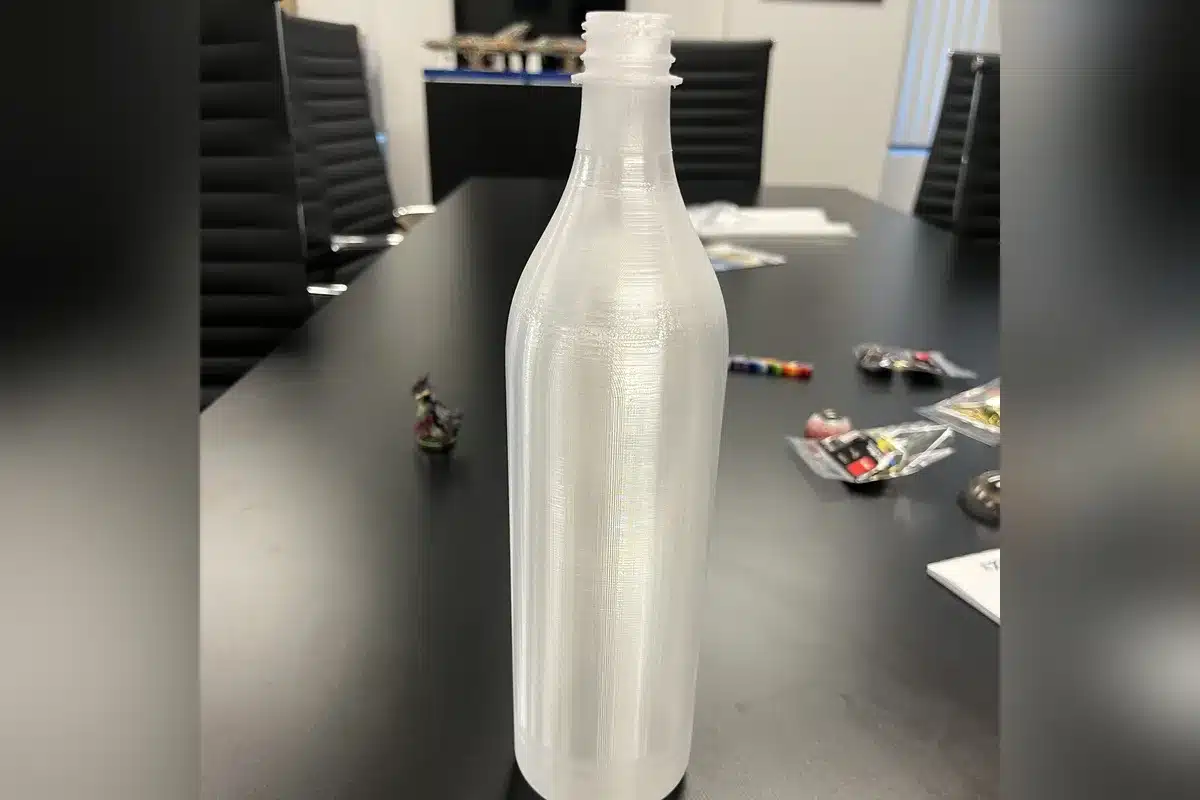
Functional prototypes
Evaluate form, fit and assembly before committing to production. Use test parts to refine clearances, mounting features and design details.
Jigs, fixtures & tooling
Create assembly aids, positioning fixtures, drill guides and custom shop tools designed around your workflow.
Low-volume production
Explore pilot runs, bridge manufacturing, replacement components and repeat orders when tooling costs or design changes make conventional production less practical.
Enclosures & housings
Develop covers, brackets and housings for electronics and equipment, with attention to mounting points, access and fit.
Larger-format models
Use our H2S build capacity for larger components or discuss how to divide an oversized design into printable sections.
Presentation parts
Combine printing with suitable finishing options for product demonstrations, display models and customer-facing prototypes.
Our process for repeatable 3D printing production
Running a print farm means balancing part requirements, material behavior, machine capacity and finishing—not simply filling build plates.
For a production quote, we work through these decisions with you so the proposed run has a clear scope.
Start with requirements
Share the part’s function, quantity, deadline and drawing. Identify critical dimensions, mating surfaces and appearance requirements before the print setup is chosen.
Choose material and orientation together
Layer direction affects strength, while supports affect surfaces and cleanup. We consider wall thickness, loading, temperature exposure and geometry as part of the production plan.
Approve the first article before production
We produce first articles for customer approval before launching a production run. Each part receives a project-specific setup based on its intended use. The first article provides the reference for reviewing fit, appearance and agreed acceptance criteria before the batch begins.
Scope the batch and its checks
Confirm the approved design revision, finish, inspection needs and delivery expectations. Tell us which features matter most so the quote reflects the checks your application requires.
Prepare for the next order
For recurring work, discuss quantities and reorder timing early. A defined part specification gives future batches a clear reference as demand or design revisions change.
3D printing materials for your application
Material selection depends on load, temperature, flexibility, environment and appearance. These are starting points for a project discussion; specific grades and availability are confirmed during quoting.
| Material family | Typical starting point | What to discuss |
|---|---|---|
| PLA | Concept models and visual prototypes | Heat exposure and functional loading |
| PETG | General-purpose prototypes, brackets and housings | Fit, surface requirements and service conditions |
| PETG ESD | Electronics handling fixtures, trays and tooling with specified electrostatic requirements | Exact grade, resistance criteria, test method and inspection scope |
| Foaming TPU · 65A–85A target Shore A | Lightweight cushioning, grips and compliant prototypes | Exact grade, target hardness, density and validation sample; not every grade spans the full range |
| ABS / ASA | Functional enclosures and tooling; ASA for outdoor exposure | Warping, dimensions and the operating environment |
| TPU | Flexible components, bumpers and soft-touch parts | Hardness, geometry and required flexibility |
| PA / PA-CF | Mechanical parts and stiff engineering components | Moisture conditioning, load direction and fit |
| PC / reinforced engineering grades | Applications requiring specific thermal or mechanical properties | Grade-specific data, geometry and validation requirements |
Send it with your file. Printed-part performance depends on the material grade and print setup, not just the polymer name. Safety-critical, regulated or demanding applications require project-specific validation.
Bambu Lab part design guidelines
Design the part around its job, then choose the print setup. The guidance below explains the decisions we review for X1E, P2S and H2S production. Final settings depend on the material grade, nozzle, geometry and approved sample.
Orientation & supports
Identify the load direction and cosmetic faces before selecting orientation. Keep support contact away from mating surfaces where practical, and leave access for removal. Enclosed cavities can trap supports; discuss splitting the part or redesigning the opening.
Normal and tree supports serve different shapes. A separate support-interface material must be compatible with the model material and machine configuration; soluble support is not a universal solution.
Overhangs & bridges
Favor self-supporting transitions over flat ledges where the design allows. Bridge performance depends on span, cooling and material; send a sample-critical feature for review rather than assuming a fixed maximum span.
Bambu Studio’s support threshold is measured from the horizontal: surfaces below the selected angle receive automatic supports. This setting is not a guaranteed printable angle for every material.
Walls & small features
Model wall thickness and slicer wall loops are separate decisions. Use enough thickness for stable toolpaths and the part’s load. Thin ribs, clips and bosses need particular attention to orientation and stress concentration.
For illustration, three 0.4 mm-wide extrusion paths occupy roughly 1.2 mm. Actual line widths and variable-width slicing change that result; it is not an SNL minimum-wall specification.
Layer thickness
Smaller layers can improve curved surfaces and vertical detail while increasing print time. Larger layers can suit simpler geometry. We select layer thickness to balance resolution and production speed, with a part-specific setup. Tell us your surface and detail requirements so we can select an appropriate layer height.
Variable layer height can refine selected regions. Layer height describes the deposited layer thickness, not the dimensional accuracy of the whole part.
Infill options
Choose pattern and density together with walls and top/bottom shells. Gyroid or cubic can be considered for functional parts; lightning can suit visual models where internal support for the top surface is the main need.
Our most common infill range is 15–20%. Wall thickness, wall loops and infill are set specifically for the intended part strength. Where the application calls for it, we use solid infill up to a 100% slicer setting. This describes the selected infill setting, not a guarantee of a void-free part. For flexible parts, wall count and infill also change how the component compresses.
Plate layout & nesting
For FDM, nesting usually means arranging parts across a build plate. It is not the unsupported vertical stacking used in powder-bed production. Preserve space for supports, brims, purge structures and machine exclusion areas.
Batch parts with compatible material and process requirements. Sequential printing also needs toolhead clearance. Submit individual models and quantities; our team can assess the production layout rather than requiring a tightly packed customer plate.
Use the exact filament grade, nozzle and printer profile when preparing a project. Moisture conditioning, temperature, cooling, flow and filament routing need to suit that grade. X1E and H2S active chamber heating provides different process options from the P2S enclosure. A profile for one machine should be reviewed before use on another.
Reference: Bambu Lab’s Bambu Studio guidance, Chapter 5. Shared slicing concepts are referenced here; H2D-specific hardware features are not offered as capabilities of our X1E, P2S or H2S fleet.
Up to four colors.
One clear color plan.
SNL Creative’s color-model service is limited to four colors per model. Provide color models in .3mf format. Export a project containing the geometry and its intended color assignments, rather than only a pre-sliced file. Include a reference image and the requested material/color names so we can check the setup.
A .3mf extension alone does not confirm that colors have been applied. If your model has no assigned colors, provide art direction: marked views showing which faces or components receive each color, a color key, and any areas that must remain a single color.
Additional color setup costs may apply when our team needs to prepare or revise the assignments. These requirements will be reviewed during quoting. Color changes can also add print time and purge material.
Four-color availability depends on filament compatibility and the production setup. Soft foaming TPU is not automatically eligible for AMS color printing. Different colors of a compatible material do not imply that any four polymers can be combined in one part.
Material color library for production parts
Our material sourcing includes Fiberon by Polymaker and 3DXTech. Each part is set up for its application, using the selected grade and its processing requirements.
These supplier references help you specify a color; they are not a list of SNL’s stocked colors. The exact grade and available colors are confirmed with your quote. Screen swatches are approximate. Request a physical sample for appearance-critical work.
| Material | Customer color reference | Production consideration |
|---|---|---|
| PLA | Bambu PLA Basic supplier palette | Basic, matte and specialty PLA have different palettes and finishes. Confirm the grade. |
| PETG | Bambu PETG supplier catalog | Confirm Basic, HF or another grade. Color names are not interchangeable between grades. |
| PETG ESD | Supplier example: Fiberon PETG-ESD, black #161618. Polymaker reference | Fiberon/Polymaker and 3DXTech grade selection is confirmed during quoting. Specify ESD requirements separately from color. |
| ABS | Bambu ABS supplier palette
OliveTangerine YellowAzureNavy BlueWhiteSilverRedOrangeBambu GreenBluePurpleBlack
|
Supplier examples below; confirm SNL availability. |
| ASA | Bambu ASA supplier palette
WhiteGrayRedGreenBlueBlack
|
Keep grade and finish consistent for appearance-critical repeats. |
| TPU | Bambu TPU supplier catalog | Choose hardness and grade first. “TPU for AMS” is a specific material, not a property of all TPU. |
| Foaming TPU | Supplier example: Siraya Tech Flex TPU Air—Black, White, Green, Icy Blue, Blush, Papaya and Lilac. Supplier palette | Exact grade confirmed during quoting. Target 65A–85A Shore hardness discussed by project; finished hardness is setup-dependent. |
| PA / nylon | Exact supplier palette to be confirmed with the selected grade. | Unfilled nylon and reinforced nylon are separate material choices. |
| PA-CF | Exact supplier palette to be confirmed with the selected grade. | Do not assume the unfilled PA color range is available in PA-CF. |
| PC | Exact supplier palette to be confirmed with the selected grade. | Confirm color, opacity and intended thermal requirements together. |
| PC-CF / reinforced grades | Exact supplier palette to be confirmed with the selected grade. | Reinforcement changes both appearance and processing requirements. |
FDM tolerances, fit and finishing
Share your drawing when a dimension is critical. FDM tolerances depend on geometry, material, orientation and process settings; a single accuracy value cannot describe every part. Threads, press fits, hinges and mating components may benefit from a test sample or secondary operation.
Visible layer lines are part of the FDM process. SNL Creative also offers surface finishing services; we can discuss preparation, painting, coatings or other options suitable for your selected material. Finishing requirements should be included in the quote because they can affect fit, appearance and lead time.
Bambu Lab 3D printing FAQs
Does SNL Creative offer Bambu Lab production printing?
Yes. SNL Creative operates a 15-printer Bambu Lab farm with 2 X1E, 10 P2S and 3 H2S machines for prototypes, tooling and production projects. Suitability, quantity and delivery timing are reviewed for each order.
What is the largest part you can print?
The H2S has a nominal build volume of 340 × 320 × 340 mm. The X1E and P2S each provide 256 × 256 × 256 mm. Orientation and supports can reduce usable space. Larger designs may be split into sections or assessed for another process.
Can you make repeat batches or end-use parts?
Yes. Share quantities, operating conditions and acceptance requirements. We set up each part for its intended application and produce first articles for approval before launching production. Material selection, part design and validation requirements determine whether FDM is appropriate.
Which files should I send for a quote?
Our online quoting page lists STL, OBJ, STP, IGES and 3MF formats. Include the intended units, quantity, preferred material, finish and target date. Add a dimensioned drawing or project notes for critical features and production requirements.
How much does Bambu Lab 3D printing cost?
Pricing depends on geometry, material, quantity, print time, supports, finishing and inspection requirements. Upload your files for a quote, or contact our team to scope a production run.
How quickly can you deliver an order?
Lead time depends on the part, quantity, material availability, finishing and current capacity. Share your target date when requesting a quote so we can confirm a realistic schedule.
Can you print in multiple colors or materials?
Our color-model service is limited to four colors per model and requires a .3mf project. Include applied color assignments or art direction showing the intended color layout. Additional color setup costs may apply. Multi-material compatibility and flexible-filament routing are reviewed separately.
Do you offer PETG ESD printing?
Yes, PETG ESD is included in our materials offering. Share the required electrostatic performance, test method and application when requesting a quote. The selected grade and printed-part validation requirements must be agreed; ordinary PETG is not a substitute for an ESD grade.
Can you print foaming TPU with 65A–85A hardness?
We offer foaming TPU projects with a target hardness in the 65A–85A Shore A range, subject to the selected grade and validated setup. Temperature, flow, foaming and part construction affect the result. Specify the desired hardness and application; we produce first articles for approval before launching production.
What infill density do you use for production parts?
Our most common infill range is 15–20%. Wall and infill settings are selected for the intended part strength, with solid infill up to a 100% slicer setting when required. Each part receives a specific setup, and first articles are approved before production.
Should I nest my parts before sending the files?
Send individual models, quantities and any orientation requirements. We can review the build-plate layout with supports, clearances and color-change requirements in mind. A customer-arranged plate may need to be rearranged for production.
Is there a universal minimum wall thickness?
No single minimum applies to every geometry and material. Wall thickness is reviewed against nozzle size, toolpaths, loading and small features. Send a drawing and identify critical walls or clips so they can be assessed before printing.
Where is SNL Creative located?
SNL Creative is based in Cypress, California, serving Orange County and the greater Los Angeles area. Contact our team to discuss project logistics.
Bring us the file.
Tell us what it needs to do.
Send your model, quantity, application and target date. For production work, include drawings, critical dimensions and finishing requirements so we can build the quote around your actual needs.
orders@snlcreative.com · (714) 420-8957 · Cypress, California
Bambu Lab production across our service areas
Our production facility is in Cypress. We make and ship production parts for teams across these cities and regions.
Orange County
Los Angeles County
San Diego County
Bay Area
Based in Cypress. Serving your team.
SNL Creative11235 Knott Ave, Suite A, Cypress, CA 90630
(714) 420-8957
orders@snlcreative.com
Contact our team to arrange a visit or discuss project logistics.
Google Maps: our Cypress production facility. Use the map link to view directions.